Picture this: you’re approaching a blind curve on a hill road near Manali, and a small yellow board with a bending arrow warns you a good fifty metres before the turn. You slow down, shift gears, and glide through safely. That little board just did more for your safety than any seatbelt reminder ever could.
Traffic signs in India work quietly in the background of every drive we take. We rarely think about them until we miss one — and then the consequences show up fast, whether it’s a skidding two-wheeler on a rain-soaked bend or a fine slapped on your e-challan account for jumping a stop line.
India’s roads carry an enormous mix of vehicles, speeds, and driving habits, from Mumbai’s expressways to narrow village lanes in Bihar. Road signs are the one common language that ties all of this together. They tell a truck driver in Punjab and a scooter rider in Kerala exactly the same thing when they see a red octagon: stop, no matter what.
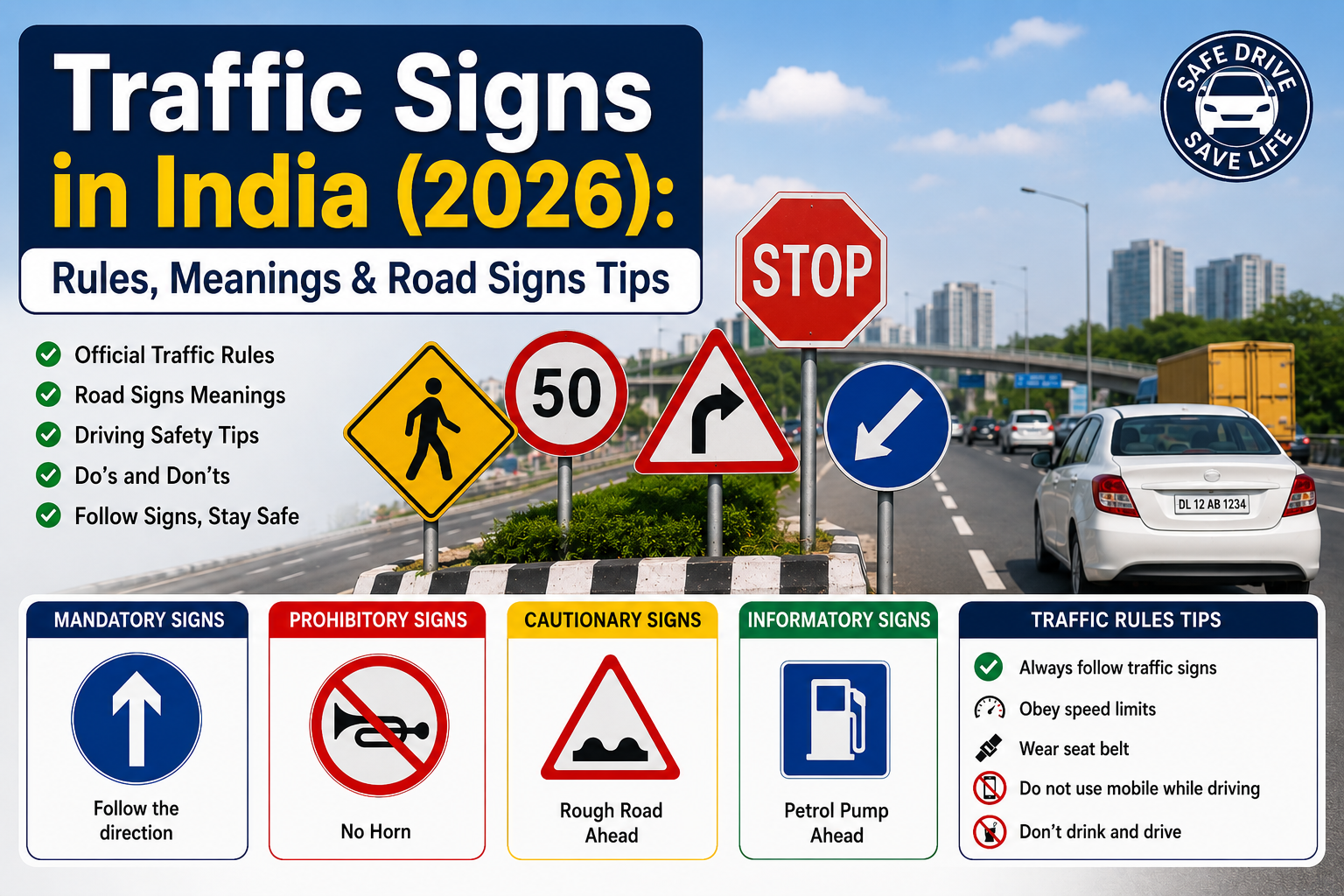
This guide walks you through every major category of Indian traffic signs meanings, explains what each one means, and shows you why knowing them matters — whether you’re preparing for your learner’s licence test, training your teenager to drive, or simply want to stop guessing at junctions.
What Are Indian Traffic Signs?
Traffic signs are standardised boards, symbols, and markings placed along roads to guide, warn, or inform drivers and pedestrians. In India, they’re designed and regulated according to Indian Roads Congress (IRC) codes, particularly IRC:67, which lays down the shapes, colours, and placement rules that traffic authorities across the country follow.
These symbols aren’t just helpful suggestions. Many of them carry legal weight under the Motor Vehicles Act, 1988, and the Central Motor Vehicles Rules, 1989. Ignore a mandatory sign like “No Entry” or “Stop,” and you’re not just being careless — you’re breaking the law and risking a fine or, in serious cases, prosecution.
Beyond the legal angle, traffic symbols exist because road behaviour needs predictability. When every driver on a stretch of road reads the same signal the same way, chaos turns into flow. A pedestrian crossing sign near a school tells every approaching vehicle, without a single word exchanged, that children may dart across at any moment.
Types of Traffic Signs in India
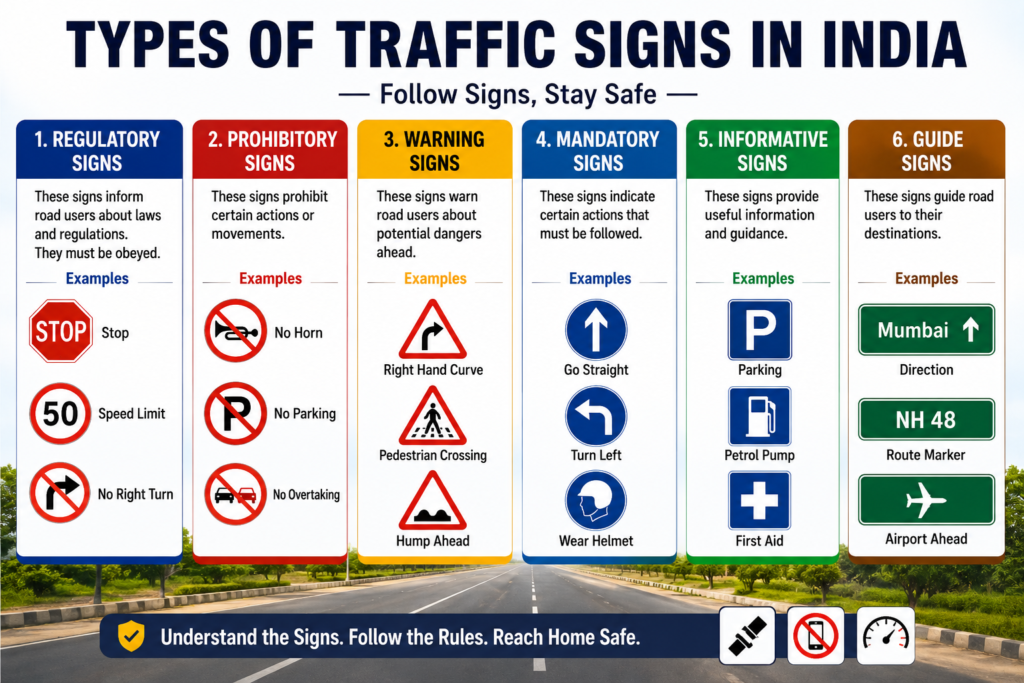
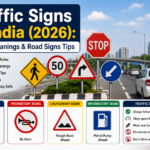
Indian traffic signs fall into three broad categories, each with its own shape, colour scheme, and purpose. Recognising the category from a distance — even before you can read the exact symbol — is often enough to know how to react.
| Category | Shape & Colour | Purpose |
| Mandatory Signs | Mostly circular, red border, white/blue background | Give legally binding instructions drivers must obey |
| Warning Signs | Triangular, red border, yellow/white background | Alert drivers to hazards or changes ahead |
| Informatory Signs | Rectangular or square, blue/green background | Provide useful information like facilities and directions |
Mandatory Traffic Signs
Mandatory signs carry the force of law. Under Section 177 of the Motor Vehicles Act, disregarding these signs can attract fines, and in cases involving accidents, harsher penalties may follow. These signs are usually round, which makes them easy to distinguish from warning triangles even from a distance.
- Stop: An octagonal red sign that means come to a complete halt before the stop line, then proceed only when the way is clear. Commonly placed at unmarked intersections and railway crossings.
- Give Way: An inverted triangle asking you to slow down and let traffic on the main road pass first. Found at minor road junctions merging into busier roads.
- No Entry: A red circle with a white horizontal bar, telling you this road or lane is off-limits from this direction. Common on one-way streets and restricted zones.
- Speed Limit: A red-bordered circle showing the maximum permissible speed in kilometres per hour. Placed near schools, residential areas, sharp bends, and highway stretches.
- No Parking: A blue circle with a red border and a diagonal red line, marking areas where stopping your vehicle is prohibited. Frequently seen outside hospitals, offices, and narrow market roads.
- One Way: A rectangular blue sign with a white arrow indicating traffic can move in only one direction. Very common in congested city centres like Old Delhi or Pune’s core areas.
- No U-turn: A circular sign showing a U-shaped arrow crossed out, meaning reversing direction here isn’t allowed. Placed on divided highways and busy intersections to prevent head-on collisions.
- Horn Prohibited: A circular sign with a horn symbol crossed out, usually near hospitals, schools, and silence zones. Honking here can attract a fine even if traffic is heavy.
Whenever you spot a circular sign, the safe assumption is that it’s giving you an instruction, not just a suggestion. Treat it that way, and you’ll rarely go wrong.
Warning Traffic Signs
Warning road signs don’t command you to do something specific the way mandatory signs do. Instead, they prepare you for what’s coming, giving you time to adjust speed, position, or attention before a hazard arrives. Their triangular shape and yellow background make them stand out sharply against most road backdrops.
- Sharp Curve: Warns of a sudden bend ahead, often seen on ghat roads and hilly stretches where visibility is limited. Ease off the accelerator well before you reach it.
- School Ahead: Alerts drivers to a school zone where children may cross unpredictably. Slow down and stay ready to brake at any moment, especially during opening and closing hours.
- Pedestrian Crossing: Indicates a marked crossing point where people on foot have the right of way. Many accidents in Indian cities happen because drivers treat this sign as optional.
- Slippery Road: Warns that the road surface may reduce tyre grip, often due to rain, oil spills, or loose gravel. Reduce speed and avoid sudden braking or sharp steering.
- Narrow Bridge: Signals that the bridge ahead is too narrow for two vehicles to pass comfortably. Slow down and be ready to give way to oncoming traffic.
- Steep Descent: Common on hill roads, this sign warns of a sharp drop in gradient ahead. Shift to a lower gear rather than relying purely on brakes to control speed.
- Cross Road: Indicates an intersecting road ahead where vehicles may appear from either side. Approach with reduced speed and check both directions.
- Roundabout Ahead: Warns that a circular junction is coming up, where you’ll need to give way to traffic already on the roundabout. Common at major city junctions.
- Men at Work: Signals ongoing road construction or repair work ahead. Expect uneven surfaces, narrowed lanes, or diversions, and slow down accordingly.
- Cattle Crossing: A distinctly Indian sign warning that animals may wander onto the road, common on rural and semi-urban stretches. Cattle rarely follow traffic rules, so this one deserves extra caution.
Every warning sign exists because someone, somewhere, learned the hard way what happens when drivers don’t get advance notice of a hazard. Respecting them costs you a few seconds; ignoring them can cost far more.
Informatory Traffic Signs
Informatory signs meanings don’t warn or instruct — they simply help you find your way or locate a facility. They’re especially useful on long highway drives or in unfamiliar cities, and their rectangular blue or green format makes them easy to spot among other road furniture.
- Hospital: Points toward the nearest medical facility, useful in emergencies or when travelling with someone unwell.
- Parking: Marks designated areas where you’re permitted to stop your vehicle, often paired with time or fee details.
- Petrol Pump: Indicates the direction and distance to the nearest fuel station, handy on long highway stretches with sparse facilities.
- Bus Stop: Marks a designated boarding and alighting point for buses, helping other drivers anticipate pedestrians and stopping buses nearby.
- Railway Station: Guides travellers toward the nearest station, common near city outskirts and highway junctions.
- Restaurant: Signals dining options ahead, frequently seen on national highways where dhabas and restaurants cluster.
- Public Telephone: An older but still-used sign pointing to public phone booths, mostly relevant in remote areas with patchy mobile coverage.
- Rest Area: Indicates a spot to pull over and rest, increasingly common on new expressways designed for long-distance travel.
- Airport: Directs travellers toward the nearest airport, typically placed well in advance on approach roads.
- Direction Boards: Show distances and directions to nearby towns and cities, essential for route planning on unfamiliar roads.
Pay closer attention to informatory signs when you’re travelling somewhere new, running low on fuel, or dealing with an emergency. On a familiar daily commute, you’ll barely notice them — and that’s exactly how they’re meant to work.
Why Traffic Signs & Signal Matter
It’s tempting to think of traffic signs as background noise on the road, but their absence makes the impact obvious. Stretches of road with faded or missing signal consistently report higher accident rates, according to road safety audits carried out by state transport departments.
- Preventing accidents: A warning sign before a sharp curve gives you the two or three seconds needed to slow down safely, which is often the difference between a smooth turn and a skid.
- Reducing confusion: At a busy, unmarked junction, drivers guess who should go first. A give-way sign removes the guesswork entirely.
- Smooth traffic flow: One-way signs and lane markings prevent the gridlock that happens when vehicles try to move in opposing directions on the same narrow stretch.
- Legal compliance: Following mandatory signs keeps you on the right side of the Motor Vehicles Act and helps you avoid challans, licence points, or court appearances.
- Safer driving overall: Drivers who consistently read and respond to signs develop sharper road awareness, which carries over into every other aspect of driving.
Think of a real scenario: a delivery rider speeding through a residential lane ignores a “Children Playing” warning sign because he’s seen it a hundred times before. The one time a child runs out unexpectedly, that familiarity turns into a tragedy that proper attention could have prevented.
Also Visit :- FASTag Recharge Online
Common Mistakes Drivers Make
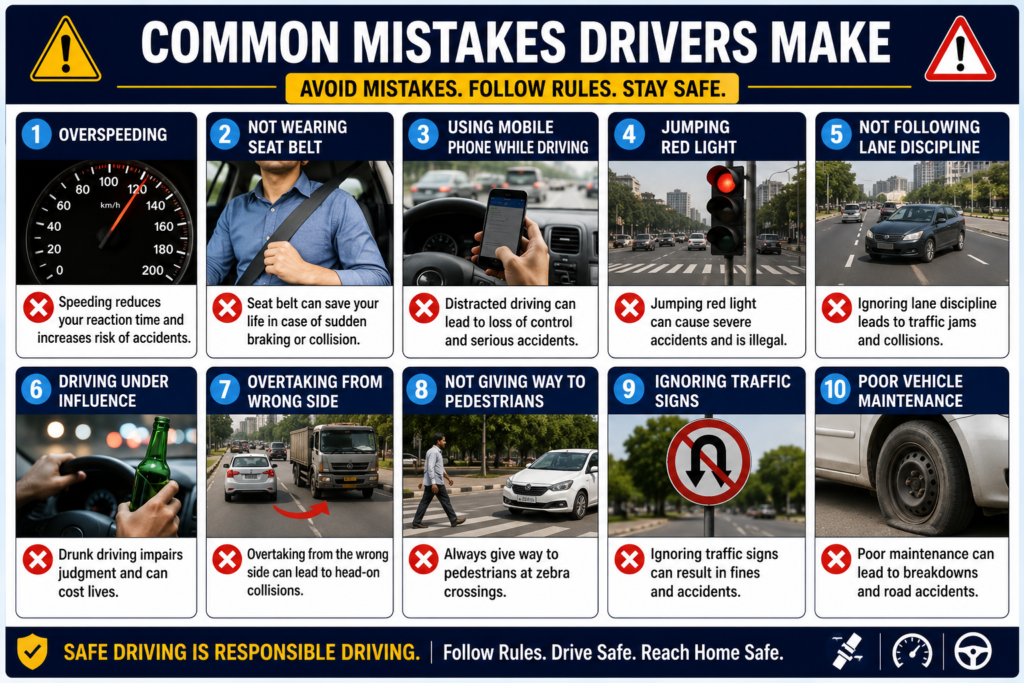
Most traffic sign violations in India don’t come from ignorance — they come from habit, hurry, or the assumption that “nothing will happen this once.”
- Ignoring speed limits: Drivers treat posted limits as suggestions rather than rules, especially on seemingly empty roads, which leaves little reaction time when a pedestrian or animal appears suddenly.
- Missing warning signs: Distracted or unfamiliar drivers often speed past yellow triangles without registering them, arriving at curves or crossings faster than is safe.
- Illegal parking: Parking near no-parking zones outside hospitals or on narrow roads causes bottlenecks and can obstruct emergency vehicles.
- Wrong-way driving: Entering a one-way street from the wrong end to save a few minutes is one of the leading causes of head-on collisions in Indian cities.
- Ignoring pedestrian crossings: Not slowing down at marked crossings puts pedestrians, particularly children and the elderly, at serious risk.
- Distracted driving: Checking a phone for even a few seconds means missing signs entirely, which is why several states now impose steep fines for mobile phone use while driving.
Each of these habits carries consequences beyond fines — points on your licence, higher insurance premiums after an accident claim, and under the newer five-strike policy some states have adopted in 2026, repeated violations within a year can even lead to licence suspension.
Traffic Signs in Driving Tests
If you’re applying for a learner’s licence, expect traffic signs to form a significant chunk of the written or computer-based test at your RTO. Most state transport departments test recognition of mandatory, warning, and informatory signs using multiple-choice questions with sign images.
The practical driving test that follows your learner’s period goes a step further. Examiners watch how you actually respond to signs in real traffic — do you slow down at a warning sign, stop fully at a stop line, or hesitate at a give-way junction? Reading a sign correctly on paper and reacting to it instinctively while driving are two different skills, and the test checks both.
A few tips make sign memorisation far easier. Group signs by shape and colour first, since that narrows down the category before you even need to recognise the symbol. Practice with flashcards or mobile apps that many RTOs and driving schools now recommend. Better still, spend a week consciously naming every sign you pass as a passenger in someone else’s car — repetition in real settings sticks far longer than rote learning from a booklet.
Road Safety Tips Every Driver Should Follow
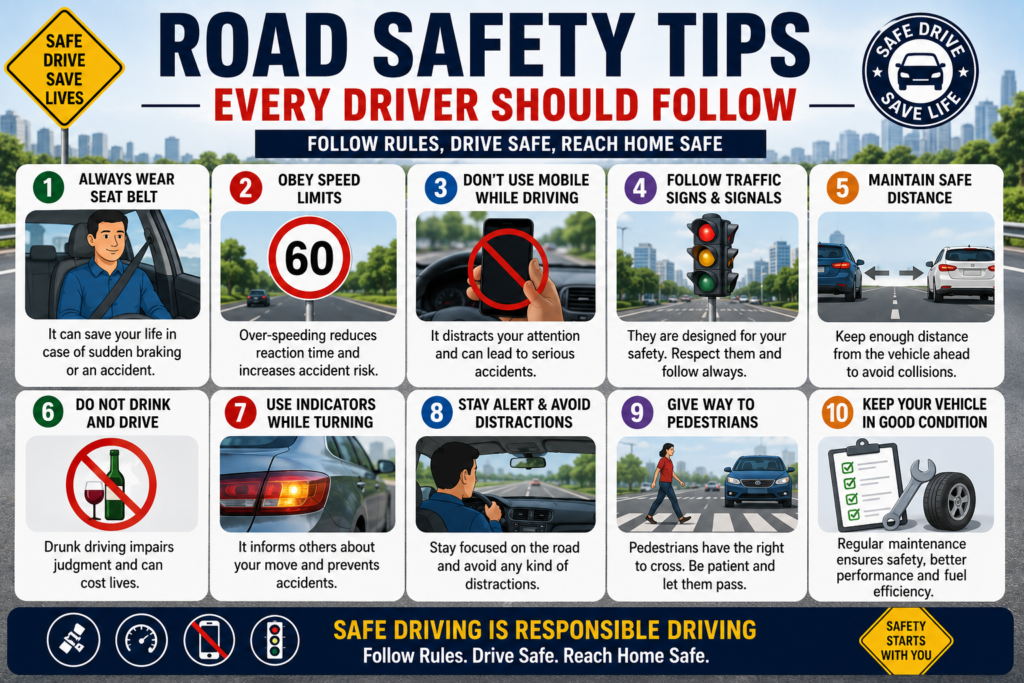
Traffic signs are one piece of a larger road safety habit. Pair sign awareness with these practices, and you cut your accident risk considerably.
- Obey all traffic signs, even on roads you drive every day.
- Follow posted speed limits, especially in school zones and residential areas.
- Wear seat belts at all times, front seat and rear seat alike.
- Wear ISI-certified helmets when riding a two-wheeler, as a rider or pillion.
- Avoid mobile phone use while driving, including for navigation unless mounted hands-free.
- Keep a safe following distance, particularly in wet or foggy conditions.
- Use indicators properly before every turn or lane change, not just when convenient.
- Never drink and drive, regardless of distance or familiarity with the route.
- Give way to emergency vehicles like ambulances and fire trucks without exception.
- Stay extra alert in school and hospital zones, where pedestrians move unpredictably.
| Practice | Why It Matters |
| Wearing seat belts/helmets | Reduces severity of injury in a collision |
| Following speed limits | Increases reaction time and reduces impact force |
| No phone while driving | Keeps full attention on the road and signs |
| Safe following distance | Prevents rear-end collisions during sudden stops |
| No drink driving | Preserves judgment and reaction time |
Frequently Asked Questions
1. What are the three types of traffic signs in India?
Indian traffic signs fall into mandatory, warning (cautionary), and informatory categories, each identifiable by a distinct shape and colour scheme under IRC guidelines.
2. Which traffic sign is most important?
There’s no single “most important” sign, but mandatory signs like Stop and No Entry carry direct legal consequences if ignored, which makes them critical to recognise instantly.
3. Are traffic signs the same across India?
The core shapes, colours, and symbols follow uniform IRC standards nationwide, though placement, enforcement, and associated fines can vary by state.
4. What happens if I ignore a mandatory sign?
You risk a fine under the Motor Vehicles Act, and in cases where ignoring the sign leads to an accident, you could face harsher legal consequences including possible licence action.
5. How can I learn traffic signs quickly?
Group signs by shape and colour, use flashcards or mobile apps, and consciously identify signs during everyday travel as a passenger to build quick recognition.
6. Are traffic signs asked in RTO exams?
Yes, sign recognition is a core part of both the learner’s licence written test and the practical driving test conducted by RTOs across India.
7. What does a yellow warning sign indicate?
A yellow triangular sign warns of an upcoming hazard or road condition, such as a sharp curve, school zone, or slippery surface, giving drivers time to react.
8. What is the difference between mandatory and warning signs?
Mandatory signs are legally binding instructions, usually circular, that you must obey. Warning signs are triangular alerts about hazards ahead, meant to prepare you rather than command a specific action.
9. Why are traffic signs important?
They prevent accidents, reduce confusion at junctions, keep traffic flowing smoothly, and help drivers stay compliant with road safety laws.
10. Where can I find official traffic rules?
The Ministry of Road Transport and Highways website, along with respective state transport department portals, publishes official rules, sign charts, and updated penalty structures.
Conclusion
Traffic signs might seem like small details scattered along the roadside, but they carry the weight of thousands of decisions drivers make every single day. Knowing what a sign means, and actually responding to it, is one of the simplest and most effective ways to keep yourself and everyone around you safe.
Rules and penalties can vary from state to state and change over time, so it’s worth checking official sources periodically rather than relying on outdated information. Whether you’re studying for your first learner’s licence test or you’ve been driving for twenty years, a quick refresher on traffic symbols in India never hurts.
Make it a habit to notice, respect, and follow every sign you pass. Safe roads start with drivers who take that small habit seriously.